No. 01
Sanders' Guides for All Students
The handouts I gave every class: how to discuss a book, read closely, build a thesis, write an abstract, cite, vary your sentences, and keep a JoYnaL. I wrote and revised them in my classrooms from 1995 through 2019. Open any card to read it.
No. 01 Discussing Books
Bryan Sanders
Reading a book means discussing a book. Do the following in class:
1. Discuss certain facts you find particularly interesting.
2. Ask other people what they found interesting.
3. Discuss what members of the group would have done if they were in the same situation as the characters.
4. Discuss which character is most important or their favorite.
5. Discuss a character that is not necessary or is a least favorite.
6. Make a statement about the book that you know everyone else would disagree with (and substantiate it, of course).
7. Discuss a particular incident in the book and discuss how it happens.
8. Speculate on what one character’s opinion of another character.
9. Compare an event in the novel to something that could have or has happened recently.
10. Plan questions ahead of time and ask to discuss them.
11. Discuss the time period in which the story takes place.
12. Pick one chapter to discuss in depth.
13. Go over the difficult parts of the book.
14. Read favorite lines or parts and say why you like them.
15. Give personal reactions, impressions of anything in particular.
16. Discuss the title of the book and how it relates to the story.
17. Discuss the symbolism of key objects, places, actions, or reactions.
18. Discuss the varying moods of the book and how the characters react to this mood.
19. Discuss any portions of the book about which you are unclear.
20. Ask people what they would do in the main character’s place.
21. Dress up as a main character.
22. Read controversial parts of the book before discussion and think about how to address them.
23. Mark pages in the book that show foreshadowing
24. Reread the book to find parts that made an impact on you.
25. Ask others to describe the theme of the book in one sentence.
26. Ask others to recount their favorite part of the book.
- Talk about what you didn’t like about the book.
28. Tell your favorite part and ask others what was their favorite part.
29. Try to answer any questions people have about the book.
30. Pick out some of the best parts and have them ready to discuss.
31. Research and share some information about criticism on the book.
32. Introduce a controversial question to the group.
33. Discuss how the book relates to the author and the author’s past works.
34. Find major themes and discuss how they fit into the book, and if they apply to life now.
35. Discuss any unknown vocabulary.
36. Discuss the setting.
37. Discuss the psychological aspect of the book.
38. Discuss the author’s use of language and effects it has on you.
No. 02 How to perform a close reading
Bryan Sanders
Guidelines for a Close Reading
You will encounter the term close reading in many disciplines. It serves as a method that asks you to pay close attention to a text in order to answer some questions about that text. Follow these guidelines to help you do a close reading:
1) Read the text once, keeping in mind the question that you bring to it. That question may come from your instructor, or it may emerge from you within the context of the course. As you read, try to locate key passages that relate to the question you have in mind. Key passages contain words or phrases that explain important ideas or convey important themes.
2) Read the text again , this time focusing on the key passages you have identified . What words or phrases in these passages have importance? Underline, highlight , or take notes so that you can later locate these passages easily .
3) Now, examine these words and phrases closely. What patterns emerge ? What ideas recur? You may have to read these words and phrases a few times to discover multiple meanings in the text : words that mean more than one thing, phrases that could yield a literal and metaphorical reading .
4) After you read these passages a few times and have discovered patterns within them, formulate a thesis statement to answer your question . This statement should reflect your inferences and speculations about the meaning of the text ; the statement should also reflect your ability to focus on one idea within the text, rather than to produce an essay merely of random impressions.
5) Structure your essay with your thesis statement as a focus . Discuss quotations from the text to create your analysis . A close analysis of a few passages will produce a stronger essay than a superficial commentary on many passages.
No. 02a Textual Analysis 4 reads
Practical Guide on How to Perform a Textual Analysis and Transform Analytical Thought into a Well-Crafted Written Composition about Literature
Authors are artists and literature is art. While they don’t use paint brushes or charcoal pencils to depict and connect ideas and images, one can decode and decipher their written passages in a manner that reveals the multivalence of text. The multiple reading levels of analysis can then be transformed into a single paragraph.
1st Reading Level: the straightforward details of the plot and context; also you can sometimes find information in the way that words are visually arranged on the page (author intent)
2nd Reading Level: the meaning found in the plot and context, and also the non-literal information embedded in the artistry of author ‘tricks’, such as connotation, imagery, symbol, metaphor, and any of the many literary and language devices (author intent)
3rd Reading Level: the connections found among significant quotations within a single text as you ‘build a case’ for comprehending and interpreting the complexity of a text’s major concepts; additionally, this level is about the connections found among multiple texts as they ‘talk’ to one another (reader intent)
4th Reading Level: the connections found when a text or group of texts is subject to your interpretation according to the principles and concepts found outside of the text; this is the use of literary theory or historical analysis or gender studies, or any of the many possible wellestablished ‘lenses’ through which you can view text(s) (reader intent)
Written by Bryan Sanders, November 2016
SAMPLE NOTES USING THE FOUR READING LEVELS Quotation: “Who’s there?”(1.1.1) – from Hamlet
1st Reading Level: This is the first line of the play and it is a question in response to a sound or a feeling that is not written into the text, which we are calling “Act Zero”; Bernardo, the guard, is standing on top of the castle walls having previously seen a ghost two nights in a row; he is also fearful because Denmark is busy preparing for an attack from Norway (author intent)
2nd Reading Level: Bernardo shows both fear and courage in his question; he has to defend and attack at once; he also shows that he believes that the ghost is a who to be named and not ignored; is the disturbance from the ghost again or a Norwegian soldier? (author intent)
3rd Reading Level: This question connects to other moments in the play where Prince Hamlet creates a variety of “who’s” in Castle Elsinore; the “antic disposition” that Hamlet puts on is the single most important line displaying his intent to pretend to be in madness and act unlike himself; also, as the theme of spying is built throughout the play, this first line could easily connect to many instances of wondering whether or not one is being watched; one could further argue that this question of who is related to the question of Godot (in Waiting For Godot) and who is he, if he indeed is, since he never shows up (reader intent)
4th Reading Level: Philosophy could be used to analyze this line because of the many existentialist questions and moments in the play as a whole; Hamlet, whether for show or not, consistently wonders about the purpose of human life on earth, and therefore ‘who is there’ serves as an interesting question that permeates throughout the play; also of use could be a cultural and historical perspective on the belief system regarding spirits, ghosts, afterlife, and underworld during Shakespeare’s day, or perhaps even during 1100’s Denmark (reader intent)
Written by Bryan Sanders, November 2016
Analytical Body Paragraph Composition: The first line of the play indicates mystery not only atop the castle walls but also within Prince Hamlet himself.1 When Barnardo gets startled because of war preparations and a visit from a ghost, he exclaims, “Who’s there?”(1.1.1)2 He experiences bravery and fear whilst saying this line, and this duality connects to the unknown presence in the ether, down below on the battlefront, and also within the characters’ minds.3 Due to the many questions that this play presents, most famously ‘to be or not to be’(3.1.64), one can easily enter a mode of philosophical musing about the characters and the play itself having enough awareness to know that they indeed exist extemporaneously.4 For what if the play within the play structures that Shakespeare codes into this storyline serve as a methodology to further and more closely come in contact with a textual self-reflection and selfawareness.5 Perhaps the play invites us to question our own inner “who’s” as we interface with Prince Hamlet’s various versions and ‘plays’.6 This also connects to some of the larger problems of the play with Hamlet putting on an ‘antic disposition’(1.5.192).7 Throughout the play, this dilemma of knowing which ‘who’ is there becomes a large part of the story and the philosophical questions that Shakespeare explores.8
Sentence #1 – should contain a 3rd or 4th Reading Level idea – this is your paragraph’s topic sentence and should offer a sneak preview of your concluding thought Sentence #2 – should contain your quotation which you integrate into your own sentence – should contain mostly 1st Reading Level ideas, and may have a sprinkle of 2nd Reading Level ideas – this sentence is where you contextualize the quotation and help place the usage of the quotation in your paragraph in order to later discuss your 3rd or 4th Reading Level idea that you named in Sentence #1 Sentence #3 – should contain 1st and 2nd Reading Level ideas – this is where you make sense of using the quotation and show how it is important to highlight in the studied text Sentence #4 – should contain 2nd and 3rd Reading Level ideas – this is where you really start to break away from the plot and the context of the quotation, and instead move towards bigger analytical thoughts in the 3rd and 4th Reading Levels Sentence #5 – should contain 3nd and 4th Reading Level ideas – by now you are likely done with the 2nd Reading Level Sentence #6 – should only contain 3nd and 4th Reading Level ideas Sentence #7 and beyond – should only contain 3nd and 4th Reading Level ideas and don’t forget to add a transition to your next body paragraph
Written by Bryan Sanders, November 2016
No. 03 Thesis Statements in a new way
by Bryan Sanders
Your Thesis Should Not Equal Feces
As you know, the thesis statement guides not only your composition but also your reader. A thesis statement names the opinion that you attempt to prove as true and to persuade your reader to agree. In order to achieve this, please use one of three different thesis statement types in every persuasive composition.
Thesis Formula: [fact] + [transition] + [opinion]
Thesis Statement Type #1 -- C ons equence (What implications could this have?)
Consequence: Demian helps Sinclair find himself, and as a result. . .
Consequence: I belong to the artist subculture, and as a result. . .
Consequence: I belong to the iPod generation, and as a result I base my value judgments of others on the depth and breadth of their iTunes playlists.
Thesis Statement Type #2 -- Significance (W hat meaning could this have?)
Significance: Demian helps Sinclair find himself, and this suggests. . .
Significance: I belong to the artist subculture, and this suggests. . .
Significance: I belong to the iPod generation and this suggests that we desire instant gratification.
Thesis Statement Type #3 -- Reason (W hat predominant factors point to caus e?)
Reason: Demian helps Sinclair find himself because. . .
Reason: I belong to the artist subculture because. . .
Reason: I belong to the iPod generation because consumerism has consumed me.
No. 04 Essay Abstract what is it
by Bryan Sanders
Writing an Essay Abstract
In order to help you prepare for an essay composition, I would like you to write a one page abstract. An abstract serves as a discussion of your ideas prior to writing the essay, and it will give me the opportunity to assess the quality of your ideas. Submit this to me before going further in the writing process so that I can provide feedback prior to a completed draft.
- The first sentence of the abstract should announce your paper’s thesis—the argument you will prove or the main idea you will try to convey.
- If you compose a piece of fiction, it still must have some core idea(s) that motivated you to write it. Therefore, I say that whatever kind of writing you do, and you will try various types this year (story, screenplay, poem, analytical essay about literature, argumentative/persuasive speech, descriptive nonfiction, skits, musicals, and on and on), you undoubtedly have something in mind that you find worth communicating. But if you don't know how to name that "something in mind" quite yet, do your best to at least name the general topic and why anyone should bother thinking about . I will help guide you in the thesis-statement-making process.
- Most (80%) of the sentences of the abstract should tell what main points you will address to prove your thesis—your evidence and how you plan to use it. You may also raise questions that you plan to answer.
- Synthesis. Be bold! Connect various examples from your life's experiences, historical events or trends, primary or secondary source material, and fiction you have studied. Prove your argument or convey your main idea through varied approaches of organization and style. Having the idea only began this journey; you now must follow through to create a writing composition that holds together.
- Conclude with a sentence or two that addresses why your argument is important in thinking about this text.
- The ending of your abstract should serve as proof to yourself that what you will spend time composing and drafting for many hours REALLY DOES capture your mind, passion, or interest! Fill in this blank: "I think my paper topic is worth writing about because ______________________." If you cannot fill in this sentence with anything but "I think it's really interesting," then you SHOULD not continue. Why would you? That would be a waste of time, no? Choose a topic or an idea that stimulates your mind and warrants further investigation. You get my drift? Write about what you CARE about or ditch it.
No. 05 Essay Abstract Example -- Romeo and Juliet
by Bryan Sanders
Essay Abstract Example -- Romeo and Juliet
I’m going to analyze how Romeo and Juliet’s untimely demise is due to Romeo’s immaturity and rash behavior.
I’ll start off with how when we first meet Romeo he establishes himself as a man driven by his emotions and how his father says nothing good can come of this. In act one, scene one, his dad comments how Romeo, “Shuts up his windows, locks fair daylight out/Black and portentous must this humor prove/unless good counsel.” I’m going to analyze how his father’s words show Romeo’s extreme emotion and then focus on the word “portentous”.
Next, I’ll look at how his emotions change quickly. Even though he’s so lovesick about Rosaline he quickly changes his love and passion for Juliet (“Did I love before now?”) and then go on to look at later when he’s banished how emotional he gets with the Friar, so much so that the Friar says to him, “Oh then I see that madmen have no ears”(3.3). I can talk about how it’s significant that the Friar calls him a “madman” and reflects Romeo’s behavior as irrational.
Then, I’ll look at all the places where he seems willing to put himself or Juliet at risk due to their love. He climbs the walls of her home, for example, and risks getting caught. Later, when he is banished, he hangs out in her room when it’s morning and says he’ll stay and be killed if that’s what Juliet wants. All of this behavior suggests that he does desperate things and probably encourages Juliet to do the same, which she does do when she goes to the Friar demanding help or she’ll kill herself.
Finally, I’ll analyze how he kills himself when he finds Juliet “dead” which is a final act of irrationality--sure he should be desperate and devastated, but to end his life is the ultimate extreme reaction. If he hadn’t done so, Juliet would have awoken and they would be together, happily ever after!
The idea that Romeo is the cause of their deaths is an interesting one to look at because Shakespeare claims that it is fate, but I think it really has to do with human behavior, and in this case Romeo is most to blame.
No. 06 Essay Abstract Example -- The Scarlet Letter
by Bryan Sanders
Essay Abstract Example -- The Scarlet Letter
I’m going to analyze how Hester Prynne’s exile from her society provides her with the knowledge that ultimately establishes her as a leader in her community.
I’ll start off with how Hester’s society is so distinct from Hester herself. I’ll look at the Puritan society and how Hawthorne describes it on page 59: “stern and tempered” and the “somber sagacity” of the age. Then I’ll look at how Hawthorne’s description of Hester’s letter ‘A’ on page 62 contrasts with the society because the letter is “so artistically done” with “so much fertility and gorgeous luxuriance of fancy.”
Next, I’ll look at the ways even though she is rejected by society she is still embraced by it, such as the parts where they come to her for her sewing.
Then, I’ll look at how Hester’s society condemning her leads her to a deeper awareness of herself. I’ll also look at how her knowledge of herself helps her to have deeper insights about those who condemn her. On page 78, Hawthorne writes that Hester realizes that “the outward guise of purity was but a lie, and that, if truth were everywhere to be shown, “a scarlet letter would blaze forth on many a bosom.” I’ll then explain how she is able to find a connection with humanity and explain how through this she becomes more aware of how openly wearing her sin helps her.
Lastly, I’ll look at the end of the book and analyze the description of her where she is alone in her house, isolated in some ways, but also a healer to other women. I can’t find the example of it yet, but I know it’s there and I can use it. I’m interested in exploring the irony that Hawthorne sets up: through her rejection by society, Hester seems to become an integral part of it. I’d like to somehow incorporate this into my ideas but I’m not sure how yet, but I think figuring it out is important to Hawthorne’s message in his book.
No. 07 How to compose an essay
Dear Students, when you write, please do these things before submitting your work:
*In a well-focused first paragraph, announce the thesis of your paper: the argument you will prove about your issue. Don't make a list of the evidence you will use; simply streamline your ideas and entice the reader with the prospect of an intriguing discussion to follow.
*In well-organized paragraphs with strong transitions, address each major point in turn, quote from the text to support every observation you make, and a close reading--a detailed analysis of the words, images, metaphors, and structure--of each quotation.
*In a final paragraph, briefly suggest how your discussion of the text contributes to a greater understanding of the subject matter--even better, try to come up with a way to connect or show intersections of literature, culture and society. Take a chance with this.
*Of course, I expect to see your very finest writing: start now so you can revise often; proofread fanatically to exorcise all grammatical, spelling, and typographical errors.
*As you know, you must reduce your usage of “to be” verbs. Consult this list.
*Word-process and double-space your essay, using one of the following 12-point fonts: Garamond, Arial or Times.
*You must also adhere rigorously to the MLA Handbook in all matters of format, citation, and documentation.
No. 08 Writing Rubric
by Bryan Sanders
`This is the scoring guide for written compositions.
5
IDEAS AND EXPLANATIONS (at least two) are insightful, thorough, convincing, varied in strategy, and strongly supported by compelling evidence.
ORGANIZATION is consistently clear, logical and appropriate for content.
STYLE is a “pleasure to read”—graceful, uncluttered, rich and vivid.
GRAMMAR AND MECHANICS errors are rare or absent.
4
IDEAS AND EXPLANATIONS (at least two) are substantial and supported by well-chosen evidence.
ORGANIZATION is logical and appropriate for content, but not as clear as a 5.
STYLE is clear, shows sentence variety, and uses interesting and precise vocabulary.
GRAMMAR AND MECHANICS errors are occasional.
3
IDEAS AND EXPLANATIONS are mostly understandable and on topic but evidence is limited and explanations are simple, obvious or too brief. May contain some plot summary or evidence-to-inference.
ORGANIZATION maintains one idea per paragraph, but is simplistic OR idea relationships are sometimes unclear.
STYLE is functional but lacks sentence variety AND vocabulary is limited or imprecise OR style is lively but wordy.
GRAMMAR AND MECHANICS errors are frequent.
2
IDEAS AND EXPLANATIONS are too simple, very repetitious, hard to follow, mostly irrelevant, inaccurate and/or contain mostly plot summary.
ORGANIZATION shows some minor skill but has major flaws—e.g. no controlling idea; poor paragraphing; redundant sections.
STYLE has major flaws—e.g., simplistic, wordy, repetitive, monotonous, often unclear.
GRAMMAR AND MECHANICS errors exist in almost every sentence and may interfere with meaning.
1
IDEAS AND EXPLANATIONS are absent, irrelevant, unsupported by evidence or incomprehensible.
ORGANIZATION lacks paragraphing, is chaotic, illogical, and confusing; OR essay is too short to have any organization.
STYLE has such severe flaws that sentences are hard to understand; OR essay is too short to judge.
GRAMMAR AND MECHANICS errors are pervasive and obstruct meaning; OR essay is too short to judge grammar/mechanics.
No. 09 Writing Rubric -- Elements of Strong Writing
Elements of Strong Writing
IDEAS & EXPLANATIONS
A. Insightful ideas or slant
B. Clear and logical explanations/arguments/analysis
C. Substantial and thorough explanations/arguments/analysis, using a variety of strategies appropriate to the purpose and audience.
D. Acknowledgment and rebuttal of strong counter-arguments
E. Well-chosen examples/evidence to support ideas. In essays about texts, evidence includes quoted passages from the text, with explanation of the context of each.
ORGANIZATION
F. Thesis, directly stated or clearly implied, that controls entire essay.
G. Introduction that grabs the reader and states or suggests the thesis
H. Logical and dramatic sequence of ideas, all relevant to the thesis, with no unnecessary repetition of ideas
I. Paragraphs, each with a directly stated or clearly implied topic that controls the entire paragraph.
J. Smooth transitions from idea to idea, both between and within paragraphs
K. Conclusion that provides satisfying and thoughtful closure
STYLE
L. Rich, precise, vivid vocabulary; strong verbs
M. Unpredictable detail and sensuous imagery
N. Metaphor without clich e
O. Dramatic, rhythmic, and appropriate variety of sentence lengths and structures
P. ‘Music’: Effective use of alliteration, assonance, rhyme, repetition
Q. No redundancy or needless repetition of words/phrases
R. Concise – no wasted words
S. Distinctive, consistent, and appropriate tone
GRAMMAR & MECHANICS
T. No run-on sentences or sentence fragments
U. No grammar/usage errors
V. No spelling errors
W. No capitalization errors
X. No punctuation errors
Y. Conventional format (heading, specific title, 1”margins, 12 point easy-to-read font, double-spaced, etc.)
Z. Proper documentation of sources (if applicable)
No. 10 How to write a paragraph
How to write a paragraph
Bryan Sanders
Paragraphs With Purpose
The 4 steps of the body paragraph format you must master:
1) Topic Sentence 2) Context of Evidence 3) Evidence 4) Discussion
Every body paragraph must have a topic sentence that announces the main idea of that paragraph. The topic sentence tells the reader what that paragraph will cover--no more, no less. In your body paragraphs, you must also discuss relevant quotations to prove your thesis--these quotations must have relevance to the main idea in the topic sentence, no doubt. A quotation must have a proper introduction. You may not allow a quotation to stand alone. If you do, you will see a comment from me that reads "NQMSA," which means No Quotation May Stand Alone. You must also choose your quotations carefully, and not over-quote, or under-discuss. Should you make one of those errors, you will see a comment from me that reads "DTWYQ," which means, Discuss That Which You Quote. Finally, should you improperly guide your paragraph with a wishy - washy topic sentence that allows more than one idea to enter into the paragraph, or should you simply wander in your discussion of the tightly defined topic sentence, you will see a comment from me that reads "NINP," which means New Idea, New Paragraph--in other words, you NEED to make a new paragraph FOR the ideas that have strayed from your original idea as stated in your topic sentence.
ALSO IMPORTANT: Please note that the word "quotation" functions as a noun, and the word "quote" functions as a verb. You do not use quotes in your compositions, you use quotations. When you need an example to strengthen your argument, you will quote from the text. See the difference?
ANALYTICAL ESSAY ABOUT LITERATURE EXAMPLE PARAGRAPH
(this is from an essay on Romeo and Juliet )
In order to change the destiny that her parents have chosen for her, Juliet must exercise her will power and take a first step. 1 When Juliet’s mother asks her if she can love the County Paris, who seeks her for his wife, she boldly replies 2 , “I’ll look to like, if looking liking move./But no more deep will I endart mine eye/than your consent gives strength to make it fly”(I, iv, 103-105). 3 Shakespeare uses alliteration here. Repeating the letter ‘L’ gives the line a softer, less harsh feeling. Juliet seems more pliable. If he had used a ‘T’ or a ‘P’ instead, it would have made Juliet seem more spiteful and angry, due to the harsher tones of those letters. In the second half of the line, Juliet says she will look as deep in Paris as she has been instructed, but no more. The words “endart” and “fly” express this. Shakespeare may have used “endart” to represent an actual dart, with Juliet’s eye serving as this dart. Sharp and pointed, Juliet will aim her dart (“look”) at her target, Paris, but will not throw it (“make it fly”), unless her parents force her. When Juliet says this, she knows she has her future written out for her by her family, in terms of who she’ll marry. She doesn’t like this path she’s taking, however, and by using verbal rebellion, this is her first step towards changing it. This shows she has a will because she has decided to take control of her own future, quietly, so as not to cause trouble. She is still keeping her will in check. 4
Footnotes:
1) Topic Sentence—This is the main idea of your paragraph. You may not discuss anything else in the paragraph. One idea per paragraph.
2) Context of Quotation—This is a short short plot summary only used to show from where the quotation comes. It is a quick reminder of what is happening in the part that you are quoting.
3) Quotation—These are the words that you find important enough to discuss and therefore are quoting. You should ONLY quote something that is meaty enough to merit discussion. Don’t just retell the story.
4) Discussion—This is the LONGEST part of your paragraph. You need to deal with your quotation. Discuss in as much depth as possible, and be sure that you stay on the topic set by your topic sentence. Do not go on to talk about other events that happen after the part you have quoted.
ANOTHER PARAGRAPH EXAMPLE
Without pizza, a community can crumble. A gathering of friends inevitably turns into a shared meal. A few weeks ago, I attended a crowded dance party and halfway through it we ordered food. When the pizza arrived, I took what I thought was fair: three slices. Three friends came and stole two of my slices; they claimed I took more than my share. I threw a bottle at them and then things spiraled out of control. Looking back, the source of the problem was the pizza order. We needed much more food to satisfy this hungry room of dancing fools. The perfect pizza should have symbolized our friendship loop, but instead it sliced us into pieces.
No. 11 How to properly cite your sources
This guide reproduced the Seattle Central Community College Library's MLA citation guide (2004), which I handed to students as is. For current MLA rules, use the MLA Style Center.
No. 12 2BR02B = to be or not to be
by Bryan Sanders
How to get rid of your “to be” verbs
(am, is, was, were, are, be, being, been)
1) To be + Verb + ing
Example : She is eating.
Suggestion : Remove the “to be” form; remove the “ing” ; adjust the verb
Revision : She eats.
2) To be + Verb + ed (the “passive” voice)
Example : The paper was presented.
Suggestion : Ask “who did the action?” Who presented the paper? The paper was presented by the teacher. Then, reverse the sentence. Put the second half of the sentence at the beginning and the first half at the end.
Revision : The teacher presented the paper.
3) To Be (solo form)
Example : She was happy.
Suggestion : Substitute a stronger verb. Frequently, this type of “to be” requires that you revise the sentence itself.
Revision : She chortled. She grinned. She purred.
(Notice that the revisions show rather than tell.)
Suggestion: Often, the true verb masks itself as a noun, adjective, or adverb elsewhere in the sentence. Unmask the true verb.
Example: The news is an example of the problem.
Revision: The news exemplifies the problem.
Example: The woman is a prominent figure in the painting.
Revision: The woman figures prominently in the painting.
----------------
E-Prime=English without ‘to be’ verbs
The 'to be' verbs overpopulate our writing.
We can write more expressive, livelier compositions without these verbs.
am;
I'm (I am);
are;
you're (you are);
they're (they are);
we're (we are);
is;
who's (who is);
that's (that is);
isn't (is not);
it's (it is);
was;
wasn't (was not);
were;
weren’t (were not);
being;
be;
can be;
could be;
shall be;
should be;
to be;
will be;
would be;
been;
has been;
have been;
shall have been;
will have been;
could have been;
should have been;
would have been
No. 13 Sentence variety makes a big difference -- read this guide
Parallel, Periodic, and Balanced Sentences and Paragraphs
First: The Simple Parallel
She looked tire d, frustrate d, and disguste d.
In the sentence above, the three underlined words are arranged in a series of coordinated elements. These elements all have the same form and the same grammatical function (adjectives which in the sentence serve as complements). Because of this similarity of form and function , they are said to be parallel constructions.
Second: The more complex parallel
A more complex parallel sentence can be one that deliberately emphasizes parallel construction. A standard sentence containing two or more coordinates constructions may be said to be parallel; but here we are concerned with the kind of parallelism that goes beyond simple combining and achieves rhythm and cadences through the deliberate repetition of parallel elements. Remember the main clause (subject and verb) comes first.
------
Robert E. Lee was a foe without hate, a friend without treachery, a soldier without cruelty. (Caton)
-----------------------------------
a new generation of Americans
born in this century,
tempered by war,
disciplined by a hard and bitter peace,
proud of their ancient heritage (Kennedy)
------------------------------------
Throughout our nation, the major cities are in trouble—
scarred by slums and ghettos,
threatened by racial strife,
crippled by inadequate finance . . .
The average American citizen is
apathetic to the political process,
confused by legislative deviousness,
manipulated by the power structure,
and ignorant of what all this can mean to his or her life.
(Yorkin)
------
NOTE: If you extend one of the parallels, or break the rhythm, keep that parallel for last.
The Parallel Paragraph
Parallelism is an excellent way to build a paragraph, as well as a sentence. When parallelism is extended through a paragraph, each sentence becomes an element in the series and states one aspect of the idea being explored.
-------
America is one of the richest and most powerful nations in the world, and can well lead the way in this revolution of values. There is nothing but a lack of social will to prevent us from paying adequate wages to schoolteachers, social workers and other servants of the public to insure that we have the best available personnel in these positions which are charged with the responsibility of guiding our future generations. There is nothing but a lack of social vision to prevent us from paying an adequate wage to every American citizen, whether he be a hospital worker, laundry worker, maid or day laborer. There is nothing--except a tragic death wish--to prevent us from reordering our priorities so the pursuit of peace will take precedence over the pursuit of war. There is nothing to keep us from remolding with bruised hands a recalcitrant status quo until we have a fashioned it into a brotherhood.
(Martin Luther King Jr. "Where Do We Go From Here?")
-------------------------------
The Periodic Sentence
A periodic sentence is a type of parallel sentence that builds through three or more parallel constructions (dependent phrases or clauses) to a main clause. Remember: in the periodic sentence, the main clause (with the subject and verb) comes last.
But if life hardly seems worth living,
If liberty is used for subhuman purposes,
If the pursuer of happiness knows nothing about the nature of their
quarry or the elementary techniques of hunting,
these constitutional rights will not be very meaningful. (E. Warren)
----------------------------------------
As long as politicians talk about withdrawal while they attack,
as long as the government invades privacy while it discusses human rights,
as long as we act in fear while speak of courage,
there can be no security,
there can be no peace.
---------------------------------------
If students are absorbed in their own limited worlds,
if they are disdainful of the work of their teachers,
if they are scornful of the lessons of the past,
then the great cultural heritage which must be transmitted from
generation to generation will be lost.
---------------------------------------
The Periodic Paragraph
A writer can create a periodic paragraph by employing the same principle of building to a main clause through dependent parallel constructions.
I guess it is easy for those of you who have never felt the stinging darts of segregation to say wait. But when you have seen vicious mobs lynch your mothers and fathers at will and drown your brothers and sisters at whim; when you have seen hate-filled policemen curse, kick, brutalize and even kill your black brothers and sisters; when you see the vast majority of your twenty million Negro brothers smothering in an air-tight cage of poverty in the midst of an affluent society; when you suddenly find your tongue twisted and your speech stammering as you seek to explain to your six- year old daughter why she can’t go to the public amusement park that has just been advertised on television, and see tears welling up in her little eyes when she is told that Funtown is closed to colored children, and see the depressing clouds of inferiority begin to form in her little mental sky, and see her begin to distort her little personality by unconsciously developing a bitterness towards white people; when you have to concoct an answer for a five-year-old son asking in agonizing pathos: Daddy, why do white people treat colored people so mean?; when you take a cross country drive and find it necessary to sleep night after night in the uncomfortable corners of your automobile because no motel will accept you; when you are humiliated day in and day out by nagging signs reading “white men” and “colored men”; when your first name becomes “nigger” and your middle name becomes “boy” (however old you are) and your last name becomes “John” and when your wife and mother are never given the respected title of “Mrs.”; when you are harried by day and hunted by night by the fact that you are a Negro, living constantly at tiptoe stance never quite knowing what to expect next, and plagued with inner fears and outer resentments, when you are forever fighting a degenerating sense of ‘nobodiness’--then you will understand why we find it difficult to wait.
(Martin Luther King Jr., Letter from a Birmingham Jail)
------
Balanced Sentences
A balanced sentence is another kind of parallel sentence in which two parallel elements are set off against each other like equal weights on a scale. In reading the sentence aloud, one tends to pause between the balanced parts, each seeming equal. When writing a balanced sentence, be certain that both parts of the sentence have the same form , that they are parallel grammatically .
George Bernard Shaw said of writers:
The ambition of the novice is to acquire the Literary Language; the struggle of the adept is to get rid of it.
[Each part of the sentence follows exactly the same pattern; subject, verb, predicate nominative.]
--------------------------------------
Content of a Balanced Sentence
Balanced sentences are particularly effective if you have an idea that has a contrast or antithesis. Balanced sentences can emphasize the contrast so that the rhetorical pattern reflects and supports the logical pattern.
------
No man has ever seen anything that Burne –Jones cannot paint, but many men have painted what Burne-Jones cannot see. (Shaw)
------
And so my fellow Americans- ask not what your country can do for you, but you can do for your country. (Kennedy)
------
If a free society cannot help the many who are poor, it cannot save the few who are rich.
(Kennedy)
------
It is not that today’s artist cannot paint, it is that today’s critics cannot see. (Rothko)
[Some of these examples illustrate not only balanced sentences but also a device called “antimetabole” in which the order of words is reversed in one of the parallel structure to produce a clever effect.]
------
The Balanced Paragraph
One can also develop an entire paragraph by balance. This is particularly useful if you are developing a series of contrasts.
I felt myself in rebellion against the Greek concept of justice. That concept excused Laius of attacking Oedipus, but condemned Oedipus for defending himself. It tolerated a king’s deliberate attempt to kill his baby son by piecing the infant’s feet and abandoning it on a mountain, but later branded the son's unintentional killing of his father as a murder. It held Oedipus responsible for his ignorance, but excused those who contributed to that ignorance. (Krutch)
No. 14 Style Notes
Some style suggestions
Questions to ask yourself about your writing
By answering the following questions and then practicing these suggestions, you'll improve your writing.
1) How long are your sentences?
You should try for some variety in sentence length. Remember that the occasional concise, simple sentence can "pack a punch" and grab a reader's attention when it's placed among a series of longer sentences. If an essay's sentences are all of the same length, none of them stand out.
2) What words do you use to begin your sentences?
Again, variety is desirable. Try to avoid "there is" or "there are" (or any other dull wording).
3) Does every word you use help your essay?
Some bland, vague words to avoid include "a lot," "a little," "things," "much," and "very."
4) How many linking verbs do you use?
The linking verb (to be) has no action, is vastly overused, and produces unimaginative prose. Replace as many of these as possible with action verbs.
5) What sentence patterns do you use?
Again, you should aim for variety; avoid using the same pattern over and over. Also, try inverting the normal order; for example, try putting a direct object at the beginning of the sentence for emphasis.
6) Are all your compound sentences joined in the same way?
The usual method is to use a comma and a coordinating conjunction (such as "and," "but," or "yet"). Try experimenting with the semicolon and the dash to add emphasis and variety (but be sure you're using these more sophisticated punctuation devices correctly).
7) How many prepositional phrases do you use?
Eliminate as many as possible, especially the possessive prepositional phrase. Change "the words of Homer" to "Homer's words."
8) Do you use any parallel construction?
Develop your ability to produce parallelisms and your writing will appear more polished and memorable.
9) Do you use any figures of speech?
If you practice incorporating the occasional use of alliteration, repetition, imagery, and other figures of speech, your writing will be more vivid and engaging.
10) What does your essay sound like?
Have a friend read your essay aloud to you and listen to how it sounds.
Finally, a word about vocabulary. Of course, the use of sophisticated language is one of your goals, but do not use words with which you're unfamiliar. Look up new words in a dictionary before you use them, especially if you find them in a thesaurus. Variety in word choice is as essential as variety in sentences, so don't try to overload an essay with fancy, multisyllabic words. Use succinct words that specifically fit your purpose.
No. 15 Transition Words
Transitional Words According to Grammatical Functions
Subordinating Conjunctions (Subordinators)
after
although
as
as if
as long as
as though
because
before
how
if
inasmuch as
in order that
provided
since
so that
than
that
though
till
unless
until
what
when
whenever
where
wherever
which
while
who
whom
whose
PATTERN: As though it made a difference, Thomas quickly carried his important load to the already sailed cargo ship.
PATTERN: Sir Topham Hatt showed much displeasure whenever any of his Really Useful Engines disappointed him.
Coordinating Conjunctions (Coordinators)
and
but
for
or
so
yet
either or
neither nor
both and
PATTERN: James the Red Engine liked to tease Thomas, but he too had recently made a mistake.
Coordinating Adverbs (Coordinators)
accordingly
also
besides
consequently
hence
however
nevertheless
moreover
otherwise
then
therefore
thus
still
PATTERN: James forgot to set his brakes before going down Gordon’s Hill and could not stop; therefore , he suffered a mighty crash into two oil tank cars just past the station.
Prepositions
about
above
across
after
against
along
all
amid
among
around
as long as
as much as
at
before
behind
below
beneath
beside
besides
between
beyond
but [except]
by
concerning
down
during
except
for
from
in
into
like
of
off
on
over
past
since
than
through
throughout
to
toward
under
underneath
until
unto
up
upon
with
within
without
To add an idea to one already stated
again
also
and
furthermore
in addition
in a like manner
in the same fashion
likewise
moreover
similarly
too
To limit, contradict or contrast something already stated
but
however
nevertheless
on the contrary
on the other hand
otherwise
yet
To indicate comparison to an idea already stated
equal with
in a like manner
in common with
likewise
much at one with
much the same as
nearly the same as
similarly
similar to
To indicate special features or examples
for example
for instance
indeed
incidentally
in fact
in other words
in particular
that is
specifically
To indicate concession to an opposing view or argument
after all
although it may be true that
although this may be true
at the same time
I admit
of course
naturally
To indicate the result of an idea(s) already stated
accordingly
as a result
consequently
hence
in short
then
therefore
thus
truly
To begin a final statement or conclusion
as a result
as I have shown
consequently
finally
for the reasons stated
for these reasons
hence
in conclusion
in summary
therefore
thus
To show a time relationship
after
at the present time
at the same time
at this point
before
during
eventually
finally
first
further
in due time
later
meanwhile
next
prior to
since
until
when
while
To show a space relationship
above
behind
below
beneath
beside
between
beyond
closer
farther
nearer
over
through
throughout
to the right
toward
under
underneath
upon
To show an importance relationship
after
also
as a result
first, second, etc.
furthermore
importantly
in addition
it follows that
more important
most important
therefore
thus
To refer back to ideas or words already used
that
these
this
those
No. 16 Comma that might have cost a lot of money
A Globe and Mail story from October 2006 by Grant Robertson about a comma in a Rogers and Aliant contract that could have cost $2 million. I handed it out as a cautionary tale about punctuation. Search "Rogers Aliant comma" to read about it.
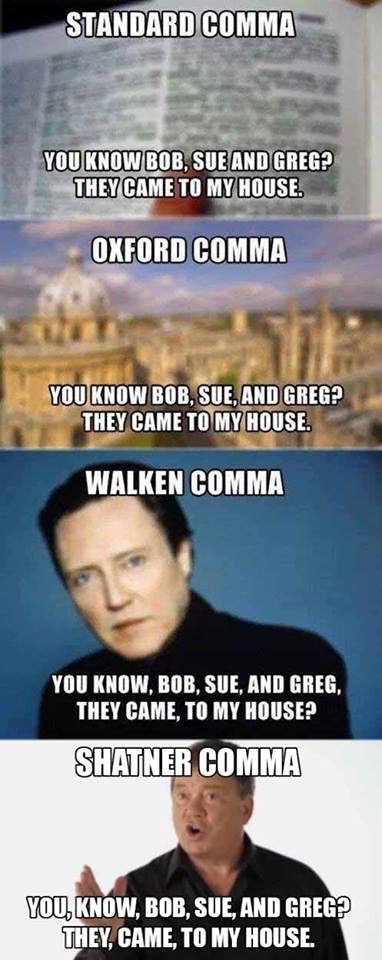
No. 17 Comma Styles
No. 18 Rhetoric -- effective writing and speaking
Language and Composition Concepts
1) Anaphora: Repetition of a word, phrase, or clause at the beginning of successive sentences or paragraphs.
2) Metaphor: Implied comparison between two things.
3) Parallel Structure: Syntactical strategy which involves repetition of grammatical form in successive phrases, sentences or paragraphs.
4) Hyperbole: Gross exaggeration.
5) Syllogism: Formula for logically presenting an argument (Major Premise, Minor Premise, Conclusion).
6) Satire: A literary work in which social institutions, vices, or follies are ridiculed and attacked. Characterized by wit, the purpose of satire is not so much to tear down, but to inspire change.
7) Tone: The way language conveys an attitude.
8) Periodic Sentence: Syntactical strategy characterized by three or more parallel constructions prior to the main clause.
9) Anecdote: Personal story used as supporting evidence.
10)Colloquial Speech: Expressions used in informal writing, but not universally accepted in formal writing.
11)Irony: Opposition between appearance and reality.
12)Ad Hominem: “To the man” -- A logical fallacy consisting of a personal attack rather than an attack on the issues.
13)Complex Sentence: Dependent Clause + Independent Clause separated by a comma.
14)Begging the Question: Fallacious form of argument in which a conclusion is presented, although a premise has not been proven.
15)Aphorism: Short, witty statement which contains a universal truth about life.
Audience: Target group (crucial for persuasion)
Ex: Ads during a football game=Rogaine, beer
Ads during Opera or a soap opera=tampons, diapers
Purpose: What you are trying to accomplish or convince.
---------------
APPEAL TO EMOTION: One of several ways writers can move their readers to accept what they say. As a means of persuasion, the writer's appeal to emotion allows words and examples to affect readers in ways that advertisements sometimes affect consumers.
Ex: Didion's meek wives studying husband's necks.
Ex: Starving children in advertisements.
APPEAL TO REASON: As a means of persuasion, the writer's appeal to reason allows facts, statistics, and logic to affect readers. This is effective because it helps establish the writer as an expert, and lends credibility to his position.
Ex: Didion's use of scientific evidence to support that the Santa Anas cause havoc.
**The best arguments have a balance of both reason and emotion.**
---------------
Denotation: The conventional dictionary definition of words
Ex: Denotation of a tourist is one who travels for pleasure.
Connotation: Meanings that have been derived from personal experience.
Ex: Connotation of a tourist if you ask someone in France might be: annoying, rude, shallow, lost, etc.
Loaded language: Language that carries along with it connotations, either positive or negative (purr vs. snarl words)
Ex: as soon as school is over, a dozen lazy teenage bums go home to school
(bums is loaded---snarl word!)
Ex: love, quietly, sweet—these words purr
---------------
Syntax: word order or sentence structure.
Specifically, parallel, periodic, and balanced sentences. These create a rhythm which is both pleasing to hear and easier to remember for the speaker and the audience. See other notes for more on syntax.
---------------
Some Additional common techniques writers use to be persuasive:
Repetition: for emphasis, memorability
Rhetorical Question: a question for which an answer is given either explicitly or implicitly.
Gets the audience to think about a question, but to also agree with the speaker or writer's answer
Allusion: by bringing in the bible, mythology, or history the writer or speaker seem to have more authority and more support for his or her view.
Anecdote: a brief story or personal example to illustrate a point.
The audience can understand the point better, can relate it more easily, can remember it better. Also, can touch our emotions more.
Ex: to say that 73% of children is LAUSD are living in poverty does not touch us as much as hearing the story of one family.
Direct Address: directly calling on the audience.
Either calling on audience as 'you' or 'fellow democrats' or _members of the senate_. Involves the audience directly and engages their interest.
Analogy: A comparison of two things, alike in certain aspects, used to explain something unfamiliar by comparing it to something more familiar.
Ex: Oreo Cookies for polarity.
A simile is an expressed analogy and a metaphor is an implied one--however these are often more imaginative and here we're talking more about logic.
Aphorism: A tersely phrased statement of a truth or opinion; an adage. A brief statement of a principle.
Syllogism: a logical presentation of an argument. A form of reasoning in which statements (premises) are made and a logical conclusion is drawn. This is reasoning from the general to the particular.
Major premise
Minor premise
Conclusion
Ex: public schools should serve all students
Samohi is a public school
Samohi should serve all students
Ex:
All men are mortal (bigger idea, that's why it's major premise)
Socrates was a man
Socrates was mortal
Must be careful; syllogism can be logical but flawed and can be effective in their impact on the audience.
Ex: public schools serve all students
Samohi is a public school
Samohi serves all students
(it’s not true but it holds logically and thus can be used to persuade)
---------------
LOGICAL FALLACIES:
Faulty or false reasoning.
There is something wrong with how you came to this conclusion.
With logical fallacies it is helpful to recognize that logical flaws are not necessarily rhetorical flaws. In fact, logical flaws may be extremely effective in their impact on the reader.
Logical fallacies are often used for propaganda purposes. Can you see why?
COMMON LOGICAL FALLACIES:
CIRCULAR REASONING: To assume in the premise what you are supposedly trying to prove in the course of your argument is to argue in a circle or "beg the question." In a circular argument there is no progression; the same thing is said in different words .
Ex: Until Osama Bin Laden stops acting like a terrorist, he's acting like a terrorist.
Ex: We shall always be free in America because we have a Democratic Government.
Ex: Bush: "If we don't succeed, we run the risk of failure."
EVADING THE ISSUE:
Distraction: Turning the course of an argument away from the main issue by raising extraneous considerations, such as emotions or sentiments. Such distractions may divert the adversary's attention and make him forget the real issue.
Ex: You say your sister's room is dirty when your mom is talking about yours.
Ex: In making a case for the democratic form of government, the arguer may eulogize George Washington and the other founding fathers, extolling their personal courage and foresight.
Ad Hominem: Directing the argument against the character of the man making the case, rather than against the case itself. This fallacy is common and sinister. Hom=root word for man.
Ex: Does it really matter who Clinton sleeps with? or are we actually attacking something else?
Ex: "She is arrogant and self-centered. Her theories of economic behavior cannot possibly be valid."
Name Calling: Another evasive smear tactic and verbal trick: calling an opposing view by a "bad name," thereby suggesting that the view is in reality bad.
Ex: Welfare-"Sheer Romanticism"
Ex: Pro-Life call Abortion: 'Murder'
Appeal to Pity: Making oneself pitiful in order to win sympathy. Another way of evading substantive issues by focusing on "poor old me."
Ex: This is how Clinton got the Ad Hominem tactics to backfire on Republicans.
Ex: When General Douglas Mac Arthur, pleading his case before the American people, cited the old refrain: "Old soldiers never die. They just fade away," he was resorting to the popular and often successful ruse of making himself pitiful in order to win sympathy.
FALLACIOUS APPEAL TO AUTHORITY: To cite a Nobel-Prize winning chemist when making a point about Civil Rights is to misunderstand the meaning of the word "authority." An authority's opinion is meaningful only when it concerns his special field of competence.
IPSE DIXIT: "He himself has spoken". Ipse Dixit holds in cases where there is an appeal to an unqualified expert. Why should Anthony Edwards, who plays a doctor on ER, know anything special about ruptured appendix?
FALSE ANALOGY: Analogies can be effective, but sometimes the dissimilarities between two things are so much greater than their similarities that their connection by analogy is unjustified.
Ex: King and Common Thief from Payne
Ex: Students are like nails. You have to hit them over the head to get them to work.
OVERSIMPLIFICATION: This is a root fallacy in which the arguer ignores the complexities of a problem so that he may solve it more easily.
Either/Or Fallacy: False dichotomy; the most common of these is the clich», "Either you are for us or against us." This statement does not acknowledge the possibility of a neutral position.
Ex: Paine: "If this isn't slavery, nothing is."
Ex: Edwards: "Either do this or go to hell" notion
Ex: Either go to school or be a failure.
Only Reason: This fallacy occurs when it is assumed that one reason alone is sufficient to explain a situation.
Post Hoc, Ergo Propter Hoc: "After this therefore, on account of it" This fallacy is an error in cause-effect analysis-a sequential relationship is misinterpreted as a causal relationship.
Ex: If I want my dog to go out, I get into my comfortable chair and read the paper.
OVERGENERALIZATION: Generalizations are conclusions about a whole category of persons, places, or things. If a statement is too broad to be proved, it is called an overgeneralization.
Ex: The British Parliament is composed of mindless tyrants.
Ex: Everyone wants to smell fresh in the morning
BANDWAGON OR SNOB APPEAL: As in jump on the bandwagon. "Everybody does or believes in this, you should too." Snob appeal is a form of bandwagon and this relates to a person's need to be special.
Ex: "Mom, I've got to get my liver pierced. Everyone is doing it!"
NON SEQUITUR: "It does not follow" and refers to any argument whose conclusion does not follow from its premises. Fallacy of irrelevance.
Ex: "Once rejected as 'preposterous!' Critics called it an outrage! It aroused incredible antagonism in scientific and literary circles. Yet half a million best copies were sold and for twenty-seven years it remained an outstanding bestseller." (We know that the popularity of a book does not bestow scientific respectability. The number of sales is thus irrelevant to the proof of the book's theoretical soundness.)
Ex: All artists are creative
Jackson is an artist
Jackson should be pensioned.
Some Possible Tone Words, Tone is the author’s attitude toward the subject
abashed
abhorring
acerbic
admiring
adoring
affectionate
aloof
ambiguous
ambivalent
angry
annoyed
antagonistic
anxious
apathetic
apologetic
appreciative
apprehensive
approving
audacious
belligerent
bemused
benevolent
bewildered
biting
bitter
brusque
burlesque
candid
casual
celebratory
cheerful
childish
choleric
clinical
cold
comic
compassionate
complimentary
conceited
concerned
conciliatory
condescending
confident
confused
contemptuous
contented
contentious
critical
cynical
depressed
derisive
derogatory
despairing
desperate
detached
diabolic
didactic
disappointed
disdainful
disliking
disrespectful
doubtful
dreary
dreamy
earnest
ecstatic
elated
elegiac
embarrassed
empathetic
enraged
eulogistic
euphoric
evasive
excited
exhilarated
expectant
facetious
familiar
fanciful
fatalistic
fearful
fervent
flippant
foreboding
friendly
frightened
frustrated
furious
gleeful
gloomy
grave
greedy
grim
gushy
happy
harsh
haughty
holier-than-thou
hopeful
hopeless
hollow
hostile
humorous
impartial
impatient
incredulous
indignant
informative
insecure
insolent
ironic
irreverent
jovial
joyful
laudatory
lethargic
light
lofty
ludicrous
lugubrious
melancholy
mirthful
mocking
moralistic
mournful
mysterious
nervous
nostalgic
objective
optimistic
outraged
paranoid
passionate
patronizing
peaceful
pedantic
pensive
pessimistic
playful
pretentious
proud
questioning
reassuring
reflective
relaxed
resigned
respectful
reverent
romantic
sad
sanguine
sarcastic
sardonic
satiric
scared
scholarly
scornful
self-assured
self-deprecating
sentimental
serious
sinister
skeptical
solemn
somber
speculative
sprightly
stately
stern
stolid
strident
suspicious
sympathetic
tender
tense
uncaring
understated
uneasy
unfriendly
unsympathetic
venerative
vitriolic
whimsical
wistful
worried
worshipful
No. 19 Word roots that you should study
Word Roots
Expand your verbal powers!
You can expand your verbal powers by learning to look an unfamiliar word squarely in the eye and asking, "What are the roots in the word, and what do they mean?" Here are fifty word parts descended from either Latin or Greek, each followed by three words containing each root. From the meanings of the clue words, deduce the meaning of each root, as in PHON - microphone, phonics, telephone = sound. Good luck. Answers below.
1. ARCH - archangel, archbishop, monarch = _______
2. ANTHROP - anthropology, misanthrope, philanthropy = _______
3. AUTO - autobiography, autograph, automaton = _______
4. BIO - biodegradable, biology, biosphere = _______
5. CAPET - capital, decapitate, per capita = _______
6. CHRON - chronic, chronology, synchronize = _______
7. CRAT - aristocrat, autocrat, democratic = _______
8. CRED - credit, creed, incredible = _______
9. CULP - culpable, culprit, exculpate = _______
10. EU - eugenics, eulogy, euphemism = _______
11. FID - confide, fidelity, perfidy = _______
12. GEN - genetic, genre, homogeneous = _______
13. GRAPH - autograph, biography, graphology = _______
14. GRAV - aggravate, grave, gravitation = _______
15. GREG - congregation, gregarious, segregate = _______
16. HYDRO - dehydrated, hydrant, hydroelectric = _______
17. LEG - legal, legislate, legitimate = _______
18. LEV - alleviate, elevate, levity = _______
19. LOQU - eloquent, loquacious, soliloquy = _______
20. MAGN - magnanimous, magnify, magnitude = _______
21. MAL - malady, malediction, malevolent = _______
22. MISS - dismiss, missile, transmission = _______
23. NOV - innovation, novelty, renovate = _______
24. OMNI - omnipotent, omniscient, omnivorous = _______
25. ONYM - anonymous, pseudonym, synonym = _______
26. ORTH - orthodontist, orthodox, orthopedic = _______
27. PAN - panacea, pandemonium, panoramic = _______
28. PED - expedition, pedal, pedestrian = _______
29. PEL - compel, propel, repel = _______
30. PHIL - bibliophile, philanthropy, philology = _______
31. POLY - polygamy, polyglot, polygon = _______
32. PORT - export, portable, transportation = _______
33. PRIM - primal, primeval, primitive = _______
34. SENT - consent, resent, sentimental = _______
35. SEQU - consecutive, obsequious, sequential = _______
36. SIMIL - assimilate, similarity, simile = _______
37. SOL - isolate, soliloquy, solitary = _______
38. SOPH - philosopher, sophistication, sophomore = _______
39. SPEC - introspective, spectacle, spectator = _______
40. SUB - sublimate, submarine, subterranean = _______
41. TELE - telegraph, telephone, television = _______
42. TEN - tenacious, tenure, untenable = _______
43. THEOS - atheism, polytheistic, theology = _______
44. TRACT - extract, intractable, tractor = _______
45. TRANS - transcontinental, transfer, translate = _______
46. VAC - evacuate, vacation, vacuum = _______
47. VERT - convert, introvert, vertigo = _______
48. VIV - survivor, vivacious, vivid = _______
49. VOC - invoke, vocal, vociferous = _______
50. VOL - malevolent, volition, voluntary = _______
Answers:
Roots: 1. leader, ruler 2. man, mankind 3. self 4. life 5. head 6. time 7. rule 8. believe 9. blame 10. good 11. faith 12. kind, species 13. write 14. heavy, weigh 15. flock, herd 16. water 17. law 18. light, rise 19. speak 20. large 21. bad 22. send 23. new 24. all 25. word, name 26. straight, correct 27. all, entire 28. foot 29. push 30. love31. many 32. carry 33. first 34. feel 35. follow 36. like 37. alone 38. wise, wisdom 39. see, look 40. under 41. far away 42. hold 43. God 44. pull 45. across 46. empty 47. turn 48. life, lively 49. call, voice 50. Wish
No. 20 Useful WWW Links
- Gatsby Comics, if you can handle it
- Speaking in E-Prime
- Working with E-Prime
- Locate an Independent Bookstore
- Common Errors in English
- Shakespeare Podcasts
- Video Poem -- "It's so hot today" ]
- Fun with Words
- Rhetoric
- Dictionary
- Urban Dictionary
- Grammarphobia
- WordINFO
- Glossary of Rhetorical Terms
- Glossary of Fallacious Arguments
- VirtualSALT
- Symbolism Dictionary
- Gutenberg Project
- RyanDorin
- SugarMegs
- UBU Web: Sound
- RadioIO
- Walter Mosley on KPCC
- The Annotated Grateful Dead
- Dancing about Architecture
- Is Protest Music Dead?
- Internet Archive
- SuperDickery
- Arts and New Media Gallery
- Everything2
- The Complete Works of William Shakespeare
- Open Source Shakespeare
- Seinfeld Scripts
- StoryCorps American Newspeak
- What Kids Can Do
- SmartMOBS
- OBEYGiant
- Jean Kilbourne
- American Newspeak
- Naropa University
- W3 School
- Searchable 1984
- Apple’s 1984 Commercial
- Newspeak Dictionary
- Beat the CPU at Checkers
- Yowl
- Howl Notes
- Literature and Culture of America 1950s
- Music for a Doomed King -- Lear
- Made with Code
No. 21 A mad list of JoYnaL Experiments
by Bryan Sanders
Your Lovely JoYnaL
WRITE IN IT EVERY DAY!
Put on your goggles
The joYnaL should remain a special creative safe haven for you. Please bring it with you to every class, and experiment with taking it around town or on weekend adventures. You should write the date on every entry. One day you might like to look back at these entries, and the date will help you track your thoughts and ideas. And we will look back periodically to reflect on our work. Do not worry about spelling, punctuation or grammar. You can fix something later if you choose to revise it or continue it.
- Homolinguistic translation: Take a poem (someone else's, then your own) and translate it "English to English" by substituting word for word, phrase for phrase, line for line, or "free" translation as response to each phrase or sentence. Or translate the poem into another literary style or a different diction, for example into a slang or vernacular. Do several different types of homolinguistic translation of a single source poem. Chaining: try this with a group, sending the poem on for "translation" from person to another until you get back to the first author.
- Homophonic translation: Take a poem in a foreign language that you can pronounce but not necessarily understand and translate the sound of the poem into English (i.e., French "blanc" to blank or "toute" to toot).
- Lexical translation: Take a poem in a foreign language that you can pronounce but not necessarily understand and translate it word for word with the help of a bilingual dictionary.
- Acrostic chance: Pick a book at random and use the title as an acrostic key phrase. For each letter of key phrase go to page number in book that corresponds (a=1, z=26) and copy as first line of poem from the first word that begins with that letter to end of line or sentence. Continue through all key letters, leaving stanza breaks to mark each new key word. Variations include using author's name as code for reading through her or his work, using your own or friend's name, picking different kinds of books for this process, devising alternative acrostic procedures.
- Tzara's hat: Everyone in a group writes down a word (alternative: phrase, line) and puts it in a hat. Poem is made according to the order in which it is randomly pulled from hat. (Solo: pick a series of words or lines from books, newspapers, magazines to put in the hat.)
- Burroughs' fold-in: Take two different pages from a newspaper or magazine article, or a book, and cut the pages in half vertically. Paste the mismatched pages together.
- Write a poem and cut it somewhere in the middle, then recombine with the beginning part following the ending part.
- General cut-ups: Write a poem composed entirely of phrases lifted from other sources. Use one source for a poem and then many; try different types of sources: literary, historical, magazines, advertisements, manuals, dictionaries, instructions, travelogues, etc.
- Cento: Write a collage made up of full-lines of selected source poems.
- Substitution (1): "Mad libs." Take a poem (or other source text) and put blanks in place of three or four words in each line, noting the part of speech under each blank. Fill in the blanks being sure not to recall the original context.
- Substitution (2): "7 up or down." Take a poem or other, possibly well-known, text and substitute another word for every noun, adjective, adverb, and verb; determine the substitute word by looking up the index word in the dictionary and going 7 up or down, or one more, until you get a syntactically suitable replacement.
- Substitution (3): Find and replace. Systematically replace one word in a source text with another word or string of words. Perform this operation serially with the same source text, increasing the number of words in the replace string.
- Serial sentences: Select one sentence each from a variety of different books or other sources. Add sentences of your own composition. Combine into one paragraph, reordering to produce the most interesting results.
- Alphabet poems: make up a poem of 26 words so that each word begins with the next letter of the alphabet. Write another alphabet poem but scramble the letter order.
- Alliteration (assonance): Write a poem in which all the words in each line begin with the same letter.
- Doubling: Starting with one sentence, write a series of paragraphs each doubling the number of sentences in the previous paragraph and including all the words used previously.
- Collaboration: Write poems with one or more other people, alternating words, lines, or stanzas (chaining or renga), writing simultaneously and collaging, rewriting, editing, supplementing the previous version. This can be done in person, via e-mail, or via regular mail.
- Group sonnet: 14 people each write one ten-word line (or alternate measure) on an index card. Order to suit.
- Write a poem in which you try to transcribe as accurately as you can your thoughts while you are writing. Don't edit anything out. Write as fast as you can without planning what you are going to say.
- Autopilot: Trying as hard as you can not to think or consider what you are writing, write as much as you can as fast you can without any editing or concern for syntax, grammar, narrative, or logic. Try to keep this going for as long as possible: one hour, two hours, three hours: don't look back don't look up.
- Dream work: Write down your dreams as the first thing you do every morning for 30 days. Apply translation and aleatoric processes to this material. Double the length of each dream. Weave them together into one poem, adding or changing or reordering material. Negate or reverse all statements ("I went down the hill to "I went up the hill," "I didn't" to "I did"). Borrow a friend's dreams and apply these techniques to them.
- Write a poem made up entirely of neologisms or nonsense words or fragments of words.
- Write a poem with each line filling in the blanks of "I used to be _____ but now I am ______." ("I used to write poems, but now I just do experiments"; "I used to make sense, but now I just make poems.")
- Write a poem consisting entirely of things you'd like to say, but never would, to a parent, lover, sibling, child, teacher, roommate, best friend, mayor, president, corporate CEO, etc.
- Take one sentence or stanza and cast it as if said to oneself silently, half-whispered, said to an intimate, said to a small group, said to a large group.
- Write a poem consisting entirely of overheard conversation.
- Non-literary forms: Write a poem in the form of an index, a table of contents, a resume, an advertisement for an imaginary or real product, an instruction manual, a travel guide, a quiz or examination, etc.
- Imitation: Write a poem in the style of each of a dozen poets who you like and dislike. Try to make it as close to a forgery of an "unknown" poem of the author as possible.
- Write a poem without mentioning any objects.
- Backwards: Reverse or alter the line sequence of a poem of your own or someone else's. Reverse the word order. Rather than reverse, scramble.
- Write an autobiographical poem without using any pronouns.
- Attention: Write down everything you hear for one hour.
- Brainard's Memory: Write a poem all of whose lines start "I remember ..."
- "Pits": Write the worst possible poem you can imagine.
- Counting: Write poems that conform to various numeric patterns for number of words in a line or sentence, number of lines in a stanza or paragraph, number of stanzas or paragraphs in a work. Alternately, count letters or syllables. Use complex numeric series or simpler fixed-number patterns.
- Write a poem just when you are on the verge of falling asleep. Write a line a day as you are falling asleep or waking up.
- List poem 1: Write a poem consisting of favorite words or phrases collected over a period of time; pick your favorite words from a particular book.
- List poem 2: write a poem consisting entirely of a list of "things", either homogenous or heterogeneous (common lists include shopping lists, things to do, lists of flowers or rocks, lists of colors, inventory lists, lists of events, lists of names, ...).
- Chronology: Make up a list of dates with associated events, real or imagined.
- Transcription: Tape a phone or live conversation between yourself and a friend. Make a poem composed entirely of transcribed parts.
- Canceling: Write a series of lines or rhymes such that every other one cancels the one before ("I come before you / to stand behind you").
- Erasure: Take a poem of your own or someone else's and cross out most of the words on each poem, retype what remains as your poem.
- Write a series of ten poems going from one to ten words in each poem. Reorder.
- Write a poem composed entirely of questions.
- Write a poem made up entirely of directions.
- Write a poem consisting only of opening lines (improvise your own lines, then use source texts).
- Write a poem consisting only of prepositions, then of prepositions and one other part of speech.
- Write a series of eight-word lines consisting of one each of each part of speech.
- Write a poem consisting of one-word lines; write a poem consisting of two-word lines; write a poem consisting of three-word lines.
- Pick 20 words, either a word list you generate yourself or from source texts. Write three different poems using only these words.
- Synchronicity: Write a poem in which all the events occur simultaneously.
- Diachronicity: Write a poem in which all the events occur in different places and at different times.
- Visual poetry: write poems with strong visual or "concrete" elements — including a combination of lexical and non-lexical (pictorial) elements. Play with alphabets and typography, placement of words on the page, etc.
- Write a series of stanzas or poems while listening to music; change type of music for each stanza or poem.
- Elimination: Cut out the second half of sentences.
- Excuses list: Write a poem made up entirely of excuses.
- Sprung Diary: Write a diary tracking and intercutting multiple levels of thoughts, experiences, anticipations, expectations, from minute to major.
- "Walking on Colors": Walk a city block or a country mile paying attention as much as possible to one color; list all the things found in this one color; write about it.
- Negation/Opposites: Negate every phrase or sentence in the poem or in some way substitute opposite words for selected words in the source text: "I went to the beach" becomes "I went to the office"; "I got up" becomes "She sat down"; "I will" become "I will not", etc. As an alternative, take a poem and change what it says line for line or phrase for phrase; not opposite, just different.
- Multilingual poem: write a poem using several languages that are integrated into the single poem.
- Pick several images from the internet or a magazine and write an accompanying poem.
- Use any of these experiments that involve as source text as a way of reading through already existing poems; that is, as interactive tools for "creative reading." As an extension, study poems via the modes of "Deformative Criticism" (the term is from Jerome McGann and Lisa Samuel). For example, take a poem and erase all but one part of speech, leaving the visual layout intact, or read it backward or otherwise re-order it, or translate it (using any of the translation exercises listed here), Alternately, use these experiments as a way to rewrite or transform your own poems.
- Make up more experiments.
- Rewrite and recombine, collage, splice together the material generated from these experiments into one long ongoing poem!
- Pick a word or phrase at random, let mind play freely around it until a few ideas have come up, then seize on one and begin to write. Try this with a non-connotative word, like "so" etc.
- Systematically eliminate the use of certain kinds of words or phrases from a piece of writing: eliminate all adjectives from a poem of your own, or take out all words beginning with 's' in Shakespeare's sonnets.
- Systematically derange the language: write a work consisting only of prepositional phrases, or, add a gerund to every line of an already existing work.
- Get a group of words, either randomly selected or thought up, then form these words (only) into a piece of writing-whatever the words allow. Let them demand their own form, or, use some words in a predetermined way. Design words.
- Eliminate material systematically from a piece of your own writing until it is "ultimately" reduced, or, read or write it backwards, line by line or word by word. Read a novel backwards.
- Using phrases relating to one subject or idea, write about another, pushing metaphor and simile as far as you can. For example, use science terms to write about childhood or philosophic language to describe a shirt.
- Take an idea, anything that interests you, or an object, then spend a few days looking and noticing, perhaps making notes on what comes up about that idea, or, try to create a situation or surrounding where everything that happens is in relation.
- Write as you think, as close as you can come to this, that is, put pen to paper and don't stop. Experiment writing fast and writing slow.
- Attempt tape recorder work, that is, recording without a text, perhaps at specific times.
- Make notes on what happens or occurs to you for a limited amount of time, then make something of it in writing.
- Get someone to write for you, pretending to be you.
- Write in a strict form, or, transform prose into a poetic form.
- Write a poem that reflects another poem, as in a mirror.
- Read or write a story or myth, then put it aside and, trying to remember it, write it five or ten times at intervals from memory. Or, make a work out of continuously saying, in a column or list, one sentence or line, over and over in different ways, until you get it "right."
- Make a pattern of repetitions.
- Take an already written work of your own and insert, at random or by choice, a paragraph or section from, for example, a psychology book or a seed catalogue. Then study the possibilities of rearranging this work or rewriting the "source."
- Experiment with writing in every person and tense every day.
- Explore the possibilities of lists, puzzles, riddles, dictionaries, almanacs, etc. Consult the thesaurus where categories for the word "word" include: word as news, word as message, word as information, word as story, word as order or command, word as vocal-able, word as instruction, promise, vow, contract.
- Write what cannot be written; for example, compose an index.
- The possibilities of synesthesia in relation to language and words: the word and the letter as sensations, colors evoked by letters, sensations caused by the sound of a word as apart from its meaning, etc. And the effect of this phenomenon on you; for example, write in the water, on a moving vehicle.
- Attempt writing in a state of mind that seems least congenial.
- Consider word and letter as forms-the concretistic distortion of a text, a multiplicity of o's or ea's, or a pleasing visual arrangement: "the mill pond of chill doubt."
- Do experiments with sensory memory: record all sense images that remain from breakfast, study which senses engage you, escape you.
- Write, taking off from visual projections, whether mental or mechanical, without thought to the word in the ordinary sense, no craft.
- Make writing experiments over a long period of time. For example, plan how much you will write for a particular work each day, perhaps one word or one page.
- Write on a piece of paper where something is already printed or written.
- Attempt to eliminate all connotation from a piece of writing and vice versa.
- Experiment with writing in a group, collaborative work: a group writing individually off of each other's work over a long period of time in the same room; a group contributing to the same work, sentence by sentence or line by line; one writer being fed information and ideas while the other writes; writing, leaving instructions for another writer to fill in what you can't describe; compiling a book or work structured by your own language around the writings of others; or a group working and writing off of each other's dream writing.
- Dream work: record dreams daily, experiment with translation or transcription of dream thought, attempt to approach the tense and incongruity appropriate to the dream, work with the dream until a poem or song emerges from it, use the dream as an alert form of the mind's activity or consciousness, consider the dream a problem-solving device, change dream characters into fictional characters, accept dream's language as a gift.
- Structure a poem or prose writing according to city streets, miles, walks, drives. For example: Take a fourteen-block walk, writing one line per block to create a sonnet; choose a city street familiar to you, walk it, make notes and use them to create a work; take a long walk with a group of writers, observe, make notes and create works, then compare them; take a long walk or drive-write one line or sentence per mile. Variations on this.
- The uses of journals. Keep a journal that is restricted to one set of ideas, for instance, a food or dream journal, a journal that is only written in when it is raining, a journal of ideas about writing, a weather journal. Remember that journals do not have to involve "good" writing-they are to be made use of. Simple one-line entries like "No snow today" can be inspiring later. Have 3 or 4 journals going at once, each with a different purpose. Create a journal that is meant to be shared and commented on by another writer--leave half of each page blank for the comments of the other.
- Type out a Shakespeare sonnet or other poem you would like to learn about/imitate double-spaced on a page. Rewrite it in between the lines.
- Find the poems you think are the worst poems ever written, either by your own self or other poets. Study them, then write a bad poem.
- Choose a subject you would like to write "about." Then attempt to write a piece that absolutely avoids any relationship to that subject. Get someone to grade you.
- Write a series of titles for as yet unwritten poems or prose pieces.
- Work with a number of objects, moving them around on a field or surface-describe their shifting relationships, resonance's, associations. Or, write a series of poems that have only to do with what you see in the place where you most often write. Or, write a poem in each room of your house or apartment. Experiment with doing this in the home you grew up in, if possible.
- Write a bestiary (a poem about real and mythical animals).
- Write five short expressions of the most adamant anger; make a work out of them.
- Write a work gazing into a mirror without using the pronoun I.
- A shocking experiment: Rip pages out of books at random (I guess you could xerox them) and study them as if they were a collection of poetic/literary material. Use this method on your old high school or college notebooks, if possible, then create an epistemological work based on the randomly chosen notebook pages.
- Meditate on a word, sound or list of ideas before beginning to write.
- Take a book of poetry you love and make a list, going through it poem by poem, of the experiments, innovations, methods, intentions, etc. involved in the creation of the works in the book.
- Write what is secret. Then write what is shared. Experiment with writing each in two different ways: veiled language, direct language.
- Write a soothing novel in twelve short paragraphs.
- Write a work that attempts to include the names of all the physical contents of the terrestrial world that you know.
- Take a piece of prose writing and turn it into poetic lines. Then, without remembering that you were planning to do this, make a poem of the first and last words of each line to see what happens. For instance, the lines (from Einstein) "When at the reception/Of sense-impressions, memory pictures/Emerge this is not yet thinking/And when. . ./Would become:/When reception/Of pictures/Emerge thinking/And when..." And so on. Form the original prose, poetic lines, and first-and-last word poem into three columns on a page. Study their relationships.
- If you have an answering machine, record all messages received for one month, then turn them into a best-selling novella.
- Write a macaronic poem (making use of as many languages as you are conversant with).
- Attempt to speak for a day only in questions; write only in questions.
- Attempt to become in a state where the mind is flooded with ideas; attempt to keep as many thoughts in mind simultaneously as possible. Then write without looking at the page, typescript or computer screen (This is "called" invisible writing).
- Choose a period of time, perhaps five or nine months. Every day, write a letter that will never be sent to a person who does or does not exist, or to a number of people who do or do not exist. Create a title for each letter and don't send them. Pile them up as a book.
- Etymological work. Experiment with investigating the etymologies of all words that interest you, including your own name(s). Approaches to etymologies: Take a work you've already written, preferably something short, look up the etymological meanings of every word in that work including words like "the" and "a". Study the histories of the words used, then rewrite the work on the basis of the etymological information found out. Another approach: Build poems and writings form the etymological families based on the Indo-European language constructs, for instance, the BHEL family: bulge, bowl, belly, boulder, billow, ball, balloon; or the OINO family: one, alone, lonely, unique, unite, unison, union; not to speak of one of the GEN families: kin, king, kindergarten, genteel, gender, generous, genius, genital, gingerly, pregnant, cognate, renaissance, and innate!
- Write a brief bibliography of the science and philosophy texts that interest you. Create a file of newspaper articles that seem to relate to the chances of writing poetry.
- Diagram a sentence in the old-fashioned way. If you don't know how, I'll be happy to show you; if you do know how, try a really long sentence, for instance from Melville.
- Turn a list of the objects that have something to do with a person who has died into a poem or poem form, in homage to that person.
- Write the same poem over and over again, in different forms, until you are weary. Another experiment: Set yourself the task of writing for four hours at a time, perhaps once, twice or seven times a week. Don't stop until hunger and/or fatigue take over. At the very least, always set aside a four-hour period once a month in which to write. This is always possible and will result in one book of poems or prose writing for each year. Then we begin to know something.
- Attempt as a writer to win the Nobel Prize in Science by finding out how thought becomes language, or does not.
- Take a traditional text like the pledge of allegiance to the flag. For every noun, replace it with one that is seventh or ninth down from the original one in the dictionary. For instance, the word "honesty" would be replaced by "honey dew melon." Investigate what happens; different dictionaries will produce different results.
- Attempt to write a poem or series of poems that will change the world. Does everything written or dreamed of do this?
- Write occasional poems for weddings, for rivers, for birthdays, for other poets' beauty, for movie stars maybe, for the anniversaries of all kinds of loving meetings, for births, for moments of knowledge, for deaths. Writing for the "occasion" is part of our purpose as poets in being-this is our work in the community wherein we belong and work as speakers for others.
- Experiment with every traditional form, so as to know it.
- Write poems and prose in which you set yourself the task of using particular words, chosen at random like the spelling exercises of children: intelligence, amazing, weigh, weight, camel, foresight, through, threw, never, now, snow, rein, rain. Make a story of that!
- Plan, structure, and write a long work. Consider what is the work now needed by the culture to cure and exact even if by accident the great exorcism of its 1998 sort-of- seeming-not-being. What do we need? What is the poem of the future?
- What is communicable now? What more is communicable?
- Compose a list of familiar phrases, or phrases that have stayed in your mind for a long time--from songs, from poems, from conversation:
What's in a name? That which we call a rose/By any other name would smell as sweet - Romeo and Juliet
A rose is a rose is a rose - Gertrude Stein
I sing the body electric... - Walt Whitman
A thing of beauty is a joy forever - Keats
Ask not for whom the bell tolls/It tolls for thee - Donne
Look homeward, Angel - Milton
For fools rush in where angels fear to tread - Pope
All's well that ends well - WS
I saw the best minds of my generation destroyed by madness - Allen Ginsberg
I think therefore I am - Descartes
It was the best of times, it was the worst of times... - Dickens
O brave new world has such people in it - Shakespeare, The Tempest, later Huxley
Water water everywhere/Nor any drop to drink - Coleridge
Curiouser and curiouser - Alice in Wonderland
- Write the longest most beautiful sentence you can imagine-make it be a whole page.
- Set yourself the task of writing in a way you've never written before, no matter who you are.
- Attempt to write in a way that's never been written before.
- Invent a new form.
- Write a perfect poem.
- Write a work that intersperses love with landlords.
- In a poem, list what you know.
- Address the poem to the reader.
- Write household poems-about cooking, shopping, eating and sleeping.
- Write dream collaborations in the lune form.
- Write poems that only make use of the words included in Basic English.
- Attempt to write about jobs and how they affect the writing of poetry.
- Write while being read to from science texts, or, write while being read to by one's lover from any text.
- Trade poems with others and do not consider them your own.
- Exercises in style: Write twenty-five or more different versions of one event.
- Review the statement: "What is happening to me, allowing for lies and exaggerations which I try to avoid, goes into my poems."
- Make a list of writing experiments.
- Write a poem in which you include some reference, explicit or implicit, to everyone you know who has committed suicide.
- "Ghost-write" poems for politicians or celebrities.
- Take a book of poetry by someone else and compose poetic responses to every single poem. Try this with a poet you hate and then with a poet you love. Try writing your poems directly in the book, if you can stand to deface it.
- Compose a "Japanese Poetic Diary"
- Write an autobiography, but including only events having to do with particular "subjects" (cooking, jazz, landlords, shoes).
- Stage elaborate contests (sestina contests, memorizing contests, rhyming contests).
- Create a "neo-classical" style that is as regular and normative as Racine. The vocabulary should be fairly limited, the syntax limpid, the versification utterly smooth. Use this style as your normal mode of communication as much as you can get away with.
- Try to get non-poets to collaborate with you on grandiose poetic projects. Test your persuasive powers.
- Convince famous painters to illustrate your work or paint your portrait, or composers to set your poems to music.
- See if Wittgenstein was right: try to invent a "private language" for your sensations.
- Invent a private slang (a la Lester Young); attempt to get as many people as you can to use the words you coin. Don't use these words in your writing; rather, conceive of the invention of this language as an independent poetic activity.
- Practice speaking in blank verse as "naturally" as possible.
- Create your own avant-garde movement; make sure you officially dissolve the movement after 6 months or a year.
- Invent an imaginary city, complete with geography, history, architecture, prominent citizens, etc... Keep a sort of "bible" of all the information you compile. Then write poems set in this city.
- Write nothing but sestinas and pantoums for a month. Then "cannibalize" them, using the best lines to write other poems.
- The "N+7" method: Replace every noun in a text with the noun seven entries after it in a dictionary. For example, "Call me Ishmael. Some years ago..." (from Moby Dick) becomes "Call me islander. Some yeggs ago...". Results will vary depending upon the dictionary used. This technique can also be performed on other lexical classes, such as verbs.
- Snowball: a poem in which each line is a single word, and each successive word is one letter longer.
- Lipogram: Writing that excludes one or more letters. The previous sentence is a lipogram in B, F, H, J, K, Q, V, Y, and Z (it doesn't contain any of those letters.)
- The prisoner's constraint (a.k.a the "macao" constraint) is a type of lipogram that omits letters with "legs" (b, d, f, g, h, j, k, l, p, q, t, and y).
- Palindromes.
- Writing experiments.
- Nonsense.
- Childhood memories.
- Overhead conversations.
- Thoughts or questions about your current reading.
- Lists of things you need to get you done, things you love or hate, or anything else.
- Ideas for stories.
- Ideas for poems.
- Drafts of stories or poems.
- Family stories.
- Things you want to remember.
- Plans for your life.
- Interviews.
- Dreams.
- Quotations.
- Song lyrics.
- Descriptions of people, places or things.
- Imagined dialogues.
- Conversations with yourself.
- Problems with the world, your own life, or the life of someone you know well.
- Really, anything and everything.